
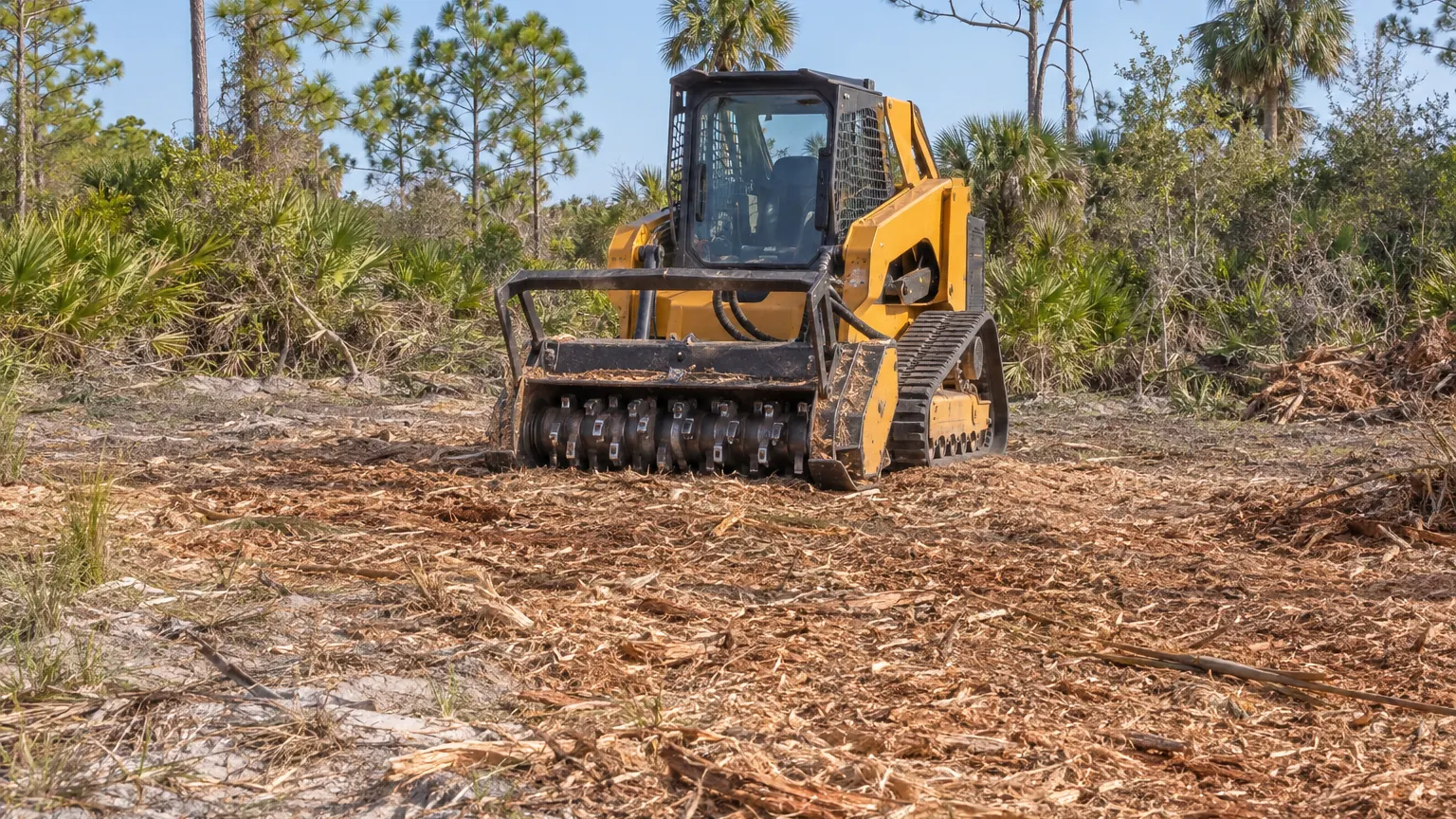
How Long Does It Take to Clear an Acre With a Forestry Mulcher in Florida?
Many Florida acres with light to moderate brush take a few hours to a full day with a forestry mulcher. Dense palmetto, vines, and large trees can stretch that to two days or more. Material size, ground conditions, and access matter more than acreage, so an on-site assessment helps refine the estimate.
How long does it take to mulch an acre of land in Florida?
There is no single answer, but there are useful ranges. These are general rules of thumb, not a promise for any specific property:
- Light cover (grass, small shrubs, thin saplings): often a few hours per acre.
- Moderate cover (mixed brush, young pines, palmetto, scattered small oaks): usually most of a day per acre.
- Heavy cover (thick understory, tangled vines, mature trees you want gone): can run a day or two per acre, sometimes more.
A mulcher does not move at a steady speed. It works through material by taking bites, backing up, and taking more. A thin acre of small stuff goes quickly. An acre with a few big trees can take longer than a thicker acre of small brush, because each large trunk takes slow, repeated passes.
Machine size matters too. A larger carrier with a bigger mulching head generally handles heavy material faster, but it needs room to get in and turn. A smaller machine fits tight spots but tends to go slower on big timber.
What slows a forestry mulcher down on Treasure Coast and Central Florida properties?
Florida land has its own habits. These are the things that most often change the clock:
- Palmetto thickets. Saw palmetto has tough, fibrous stems and sprawling root mats. Dense stands can slow the head down more than their height suggests.
- Brazilian pepper, vines, and tangled understory. Dense, woody, multi-stem growth has to be taken in many small bites. Vines can wrap the head and force stops to clear it.
- Tree size. Anything with a thick trunk, such as mature oaks or large pines, takes much longer than the same area of small stems. Some large trees are better handled as tree removal first.
- Wet or soft ground. Much Florida ground is sandy and drains well, but low spots, flatwoods, and areas near ditches or ponds can hold water. Soft ground limits where a heavy machine can safely travel, and the crew may work around wet areas or wait.
- Hidden debris. Old fence wire, buried concrete, cable, and trash are common on land that has sat for years. Metal can damage mulching teeth, so operators slow down and check.
- Protected species and sensitive areas. Gopher tortoise burrows, wetlands, and similar features can require surveys, buffers, or permits before work starts. Rules vary, so check with your county and the state wildlife agency early.
The shape of the parcel affects the schedule in a different way. A long, narrow strip takes more turning and repositioning per acre than a square one. Finishing details, like cutting close to fences, trees you are keeping, or a pond edge, also add time.
Mulching vs. pushing and hauling: how do the timelines compare?
Mulching leaves the vegetation on site as a layer of chopped material. Traditional clearing pushes it into piles, then burns or hauls it. The timelines differ because the work is shaped differently.
- Forestry mulching: the material is ground up and left on site. Dense or large material and soft ground are the usual causes of delay.
- Push and pile: the material is pushed into piles on site. The clearing itself can be quick, but pile size and burn or disposal rules can add steps afterward.
- Push and haul: the material is loaded and trucked away. Loading, hauling trips, and disposal site access can add time, depending on the property.
In many cases mulching has a short path from overgrown to usable because there is no pile management or hauling phase. It is not always the right method, though. If you want bare, graded dirt for a building pad, you may need extra earthwork after the mulch is down. Equipment, vegetation, and the finished condition you want all change the comparison, so fewer steps usually means a shorter schedule, but not every time.
What other work can affect the schedule?
The mulcher gets the attention, but a job often needs more than one tool. Depending on the property, that can mean pulling stumps or digging out problem spots, cutting trees that are too large or too close to structures, or grinding stumps below grade. Each added step can add time.
A mulcher cuts stumps close to the ground but does not remove the root system. If you plan to build, plant grass, or run a mower over the area, ask early whether stump grinding should be part of the plan. We offer tree removal and stump grinding as part of our land clearing work, so ask us how it can be coordinated with the mulching.
Planning tools can help too. We use GPS-guided equipment and drone mapping, which can make it easier to mark boundaries, define the clearing area, and check progress against the plan. A clear map up front helps everyone agree on where the work stops.
For the mulching itself, our brush mowing and mulching service covers overgrown lots, fence lines, and larger acreage.
How do you prepare your property so work can start on time?
In much of Florida the dry season typically begins around November, and many landowners schedule clearing then. Ground is often firmer and access is easier, so calendars can fill up. A few things on your side keep the start date from slipping:
- Mark property lines. Do not assume the crew can find them. If corners are not obvious, have a survey done or flag the lines clearly. Mulching past a boundary cannot be undone.
- Flag what stays. Mark trees, native plants, wells, septic tanks and drain fields, utility lines, and anything else that must be protected. Tie bright ribbon, and tell the crew in writing.
- Make sure there is access. A locked gate, a soft driveway, or a narrow entry can stop heavy equipment. Confirm that a trailer can get in and where it can park.
- Remove loose junk. Old fencing, tires, appliances, and trash on the ground are hazards for a mulcher. If you know where something is, say so.
- Check permits and local rules. Tree removal, wetlands, and protected species rules vary by city and county. Contact your local planning or permitting office before the work starts.
How should you ask a contractor for a realistic timeline?
Be wary of anyone who quotes hours per acre without learning about the land. Aerial photos and property records can show some vegetation and drainage features, and an on-site assessment helps refine the estimate by confirming density, soil, and hazards. Ask these questions:
- What is the dominant vegetation, and how thick is it?
- Are there large trees, and will they be handled separately?
- What is the plan for wet spots?
- Will stumps be ground, left, or pulled?
- What happens if the crew finds debris, protected species, or other surprises?
- What is the weather plan if a rain event pauses work?
A good answer is specific to your property and admits what is unknown. We take the time to assess each property and recommend the right approach, since soil, drainage, and vegetation are different on every parcel. If you want a clearer idea of how long your acreage might take, you are welcome to reach out through our contact page and describe what you have.
Frequently asked questions
Does thick palmetto or Brazilian pepper take longer to mulch?
Often, yes. Dense palmetto and Brazilian pepper are tough, woody, and tangled, so the mulcher may need to take smaller bites and back up often. An acre of these can take noticeably longer than an acre of grass and small shrubs. Brazilian pepper also tends to regrow if the stumps are not treated afterward.
Can you mulch land when the ground is wet?
Sometimes, but it depends on how soft the ground is. Heavy machines can rut or bog down in saturated soil, and ruts can be costly to repair. Work is often done in dry areas first, low spots may be skipped, or the job may wait for conditions to improve. That is one reason many people schedule clearing in the dry season.
What happens to the mulch left on the ground?
It stays as a layer of chopped wood and plant material. That layer can help hold soil in place and slow weeds for a while, then it breaks down over time. If you plan to seed grass or build, ask how thick the layer will be and whether it should be raked or removed.
Do you need to mark property lines before clearing?
Yes. A crew can only clear to the lines it is shown, and mulching beyond a boundary cannot be reversed. If your corners are not clear, get a survey or flag the lines before work begins. Also flag trees, wells, and septic components that must stay.
Does mulching leave stumps behind?
Usually yes, though a mulcher cuts them low, often close to ground level. The roots stay in the ground. If you plan to build, farm, or mow over the area, ask about stump grinding or removal so you are not surprised later.


